
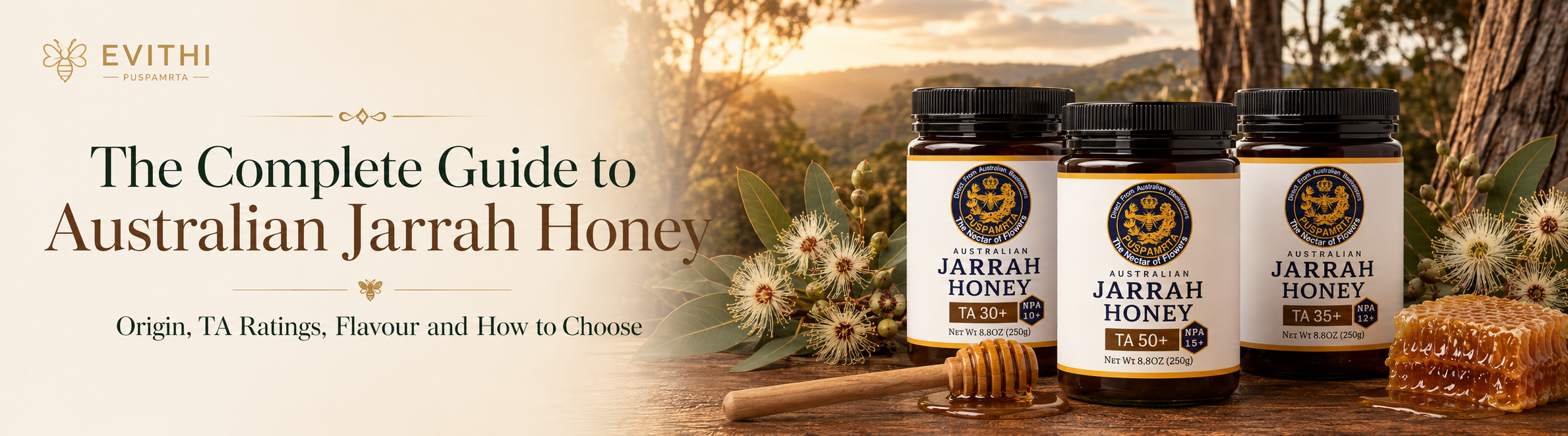
Australian Jarrah honey is produced when bees collect nectar from the cream-coloured flowers of the Jarrah tree, Eucalyptus marginata, in Western Australia. It is recognised for its deep amber appearance, distinctive flavour, slow tendency to crystallise and the TA grading information displayed on many premium Jarrah honey products.
This complete guide explains where Jarrah honey comes from, how it moves from forest blossom to jar, what a TA rating means, how TA30+, TA35+ and TA50+ products differ in labelled positioning, and how to compare jar sizes, pack quantities and product information.
Jarrah honey is a food. TA should be understood as a laboratory activity grading reference, not as a medical recommendation or a promise to diagnose, treat, cure or prevent disease.
Contents
What is Australian Jarrah honey?
The Jarrah tree and Western Australian origin
How Jarrah honey moves from blossom to jar
What does TA mean in Jarrah honey?
TA30+, TA35+ and TA50+ explained
Taste, colour and texture
Seasonality and natural batch variation
Laboratory testing and authenticity
Does Jarrah honey crystallise?
How to choose Jarrah honey
Jar sizes and pack options
Ways to enjoy Jarrah honey
How to store Jarrah honey
Why Jarrah honey prices vary
Frequently asked questions
What Is Australian Jarrah Honey?
Australian Jarrah honey is a floral honey associated with nectar gathered from the Jarrah tree, Eucalyptus marginata. The tree is native to Western Australia, and authentic Jarrah honey is closely connected with the forests and flowering conditions of the state’s south-west.
Like all honey, Jarrah honey begins as nectar collected by bees. The botanical source, local environment, rainfall, temperature, flowering intensity, hive location and harvest timing all influence the finished jar. These factors help explain why different batches can show natural changes in colour, aroma, thickness and flavour.
Jarrah honey is commonly positioned as a premium Western Australian food. This positioning reflects its distinctive floral origin, variable flowering cycle, limited seasonal supply, laboratory grading and specialised market. Premium positioning does not mean every Jarrah product is identical or that the highest grade is automatically the right choice for every buyer.
When comparing Jarrah honey online, look beyond the front label. Check the country and region of origin, TA rating, net weight, jar size, pack quantity, supplier details and any available batch or testing information.
The Jarrah Tree and Western Australian Origin
[1]
The Jarrah tree is strongly associated with the south-west of Western Australia. The region’s forests, iron-rich soils and Mediterranean-style climate create the natural setting in which Jarrah flowers and beekeepers position hives during suitable seasons.
[2]
This variable flowering pattern matters to honey production. Beekeepers cannot assume that every location will produce the same quantity in every season. Flowering strength, weather and nectar flow influence whether a particular harvest is abundant, modest or unavailable.
Because Jarrah is a named botanical and regional honey, accurate origin information is important. A generic dark honey should not be assumed to be Jarrah simply because its colour looks similar.
How Jarrah Honey Moves from Blossom to Jar
The process begins when worker bees visit Jarrah blossoms and collect nectar. The nectar is carried back to the hive, transferred between bees, combined with naturally occurring enzymes and placed into honeycomb cells.
Bees reduce the moisture in the nectar by moving air through the hive. Once the honey has matured, the cells are capped with wax. Beekeepers later remove suitable frames, uncap the wax and extract the honey from the comb.
After extraction, the honey may be allowed to settle, strained to remove larger wax particles, filtered for greater clarity, gently warmed to help with handling or packed with minimal processing. These decisions influence the appearance and pourability of the finished product.
Processing style does not replace botanical origin or testing. A clear jar is not automatically more authentic than a cloudy jar, and a thick jar is not automatically a higher grade. Buyers should rely on origin, labelling and relevant documentation rather than appearance alone.
What Does TA Mean in Jarrah Honey?
TA means total activity. It is a laboratory activity grading reference used on some Australian honey labels. TA communicates measured activity under the test method used by the laboratory and provides a way to compare labelled products within the same grading approach.
TA is not the same as MGO, NPA or UMF. MGO is a measured concentration commonly shown on Manuka honey. NPA is a non-peroxide activity reference. UMF is a licensed New Zealand quality-assurance system. TA is a different grading reference and should be read on its own terms.
A TA30+ label means the product is presented as meeting or exceeding a TA level of 30 under the relevant test. TA35+ and TA50+ indicate higher labelled activity values. The plus sign means “at least” the stated number rather than exactly equal to it.
The number should not be used to assign a disease, treatment purpose or recommended dose. It is most useful as a product-comparison tool when considered together with origin, jar size, brand, current price and intended use.
Testing methods and reporting practices can differ, so customers should read the supplier’s explanation and review batch documentation when it is available. A grading claim should apply to the actual product being sold.
TA30+, TA35+ and TA50+ Jarrah Honey Explained
Evithi’s Jarrah honey range includes TA30+, TA35+ and TA50+ category options. The table below explains how these grades are positioned for comparison. Current sizes, pack quantities, pricing and availability should always be confirmed on the live product pages.
| Jarrah grade | Position in the range | Browse |
|---|---|---|
| TA30+ | Premium Jarrah honey grade for customers beginning to compare TA-labelled products | Browse TA30+ |
| TA35+ | Higher labelled TA grade positioned above TA30+ within the Evithi Jarrah range | Browse TA35+ |
| TA50+ | Flagship upper-range TA-labelled Jarrah honey selection | Browse TA50+ |
Jarrah TA50+ product page. Use the live listing to confirm its current jar sizes, pack options, price and stock status.
A higher number means a higher labelled TA result. It does not automatically mean the product will taste stronger, look darker or suit every customer better. Flavour preference, budget, presentation and quantity remain important.
Jarrah Honey Taste, Colour and Texture
[2]
Taste is naturally subjective. Customers may describe Jarrah honey as malty, caramel-like, woody, smooth or full-flavoured. The exact experience depends on the harvest, floral dominance, storage and individual palate.
[3]
Colour alone cannot confirm quality or TA grade. A darker jar may simply reflect floral and seasonal differences. Likewise, thickness can change with temperature and sugar balance.
Natural batch variation is normal. Two genuine Jarrah honey jars from different seasons may not look exactly the same, even when they carry the same grade and brand.
Seasonality and Natural Batch Variation
Jarrah honey is an agricultural food connected with a flowering forest tree. Production depends on conditions that cannot be controlled in the same way as a manufactured food formula.
1. Rainfall: winter rainfall can influence tree condition and later flowering.
2. Spring warmth: temperature can affect flowering and nectar flow.
3. Hive location: access to a strong Jarrah flowering area affects the nectar collected.
4. Competing flowers: other plants flowering nearby can influence whether a harvest is strongly monofloral or more mixed.
5. Harvest timing: the timing of hive placement and extraction can affect the character of the batch.
6. Storage temperature: temperature influences viscosity and crystallisation after packing.
[2] This helps explain why supply and pricing may change between seasons.
Laboratory Testing and Jarrah Honey Authenticity
Jarrah honey authenticity cannot be proven by a simple home test. Water tests, thumb tests, flame tests, colour checks and crystallisation myths are not reliable ways to confirm botanical origin or TA grade.
Laboratory work may examine general honey-quality measurements, activity results and chemical characteristics. Relevant tests can include moisture, acidity, electrical conductivity, sugar profile, enzyme activity and HMF, depending on the purpose of the analysis.
[3]
The same study noted that there was no standard method for Jarrah authentication at the time of publication. This means sellers should avoid overstating certification or authenticity systems that they cannot substantiate.
When buying online, use practical trust signals. Look for a complete product name, Western Australian origin, a clearly identified TA grade, net weight, supplier information and batch details where applicable. Any certificate or laboratory report should clearly relate to the product being sold.
[4] Clear, accurate wording is therefore important for both customers and sellers.
Does Jarrah Honey Crystallise?
Jarrah honey can crystallise, but it is often described as slower to crystallise than many other honeys. Crystallisation is a natural physical process in which dissolved sugars form crystals.
[3] Sugar balance is one reason different floral honeys crystallise at different rates.
Crystallisation does not automatically mean the honey is spoiled, diluted or poor quality. Crystallised Jarrah honey can be eaten as it is and may be easier to spread.
To soften it, place the closed jar in warm water and allow it to warm gradually. Avoid boiling the honey or exposing a plastic container directly to excessive heat.
How to Choose Australian Jarrah Honey
The most suitable Jarrah honey depends on the buyer’s priorities. The highest TA number is not automatically the correct choice for every purchase.
1. For a first Jarrah purchase: compare TA30+ with a jar size that allows you to explore the flavour without buying more than you need.
2. For a higher labelled grade: compare TA35+ with TA30+ by price, jar size, presentation and current availability.
3. For a flagship purchase or gift: compare TA50+ according to budget, recipient familiarity, packaging and pack quantity.
4. For everyday food use: choose a quantity and flavour you will use regularly rather than selecting by grade alone.
5. For multipacks: compare the total weight, price per jar, discount and likely storage period before ordering.
6. For online buying: check the live product title, net weight, TA grade, country of origin and supplier information.
The Complete Guide to Australian Honey.
Jar Sizes and Pack Options
Jar size changes the total purchase quantity and often affects value by weight. A smaller jar may suit first-time tasting or gifting, while a larger jar may suit regular household use.
Pack quantity also matters. A single jar offers the lowest total commitment. Packs of two or more may suit shared orders, hampers, corporate gifting or customers who use honey regularly.
Do not rely on a general guide for current sizes or discounts. Product listings can change. Always confirm the live jar size, pack quantity, stock status, shipping information and final checkout price.
Australian Jarrah honey collection to compare the current range.
Ways to Enjoy Jarrah Honey
1. Drizzle it over toast, pancakes, porridge or yoghurt.
2. Pair it with fruit, nuts or cheese on a food platter.
3. Stir it into warm tea after the drink has cooled slightly.
4. Add it to salad dressings with olive oil, mustard and vinegar.
5. Use it in marinades and glazes where a deeper honey flavour suits the recipe.
6. Include it in baking with oats, spices, fruit or nuts.
7. Add a premium jar to an Australian food hamper or corporate gift.
Jarrah honey can have a deeper flavour than mild table honey, so begin with a smaller amount and adjust according to taste.
How to Store Jarrah Honey
Keep the jar tightly closed in a clean, dry cupboard away from direct sunlight and excessive heat. Use a clean, dry spoon so that moisture, crumbs or other food are not introduced into the jar.
Ordinary refrigeration is generally unnecessary and can encourage a thicker texture or faster crystallisation. Follow any specific instructions printed on the product label.
Natural changes in colour, thickness and crystal formation can occur during storage. These changes are different from packaging damage, contamination or fermentation. Do not use a jar when its seal is damaged or when there are signs that the product has been contaminated.
Honey is not suitable for children under 12 months of age.
Why Jarrah Honey Prices Vary
Jarrah honey prices can differ between grades, jar sizes, sellers and seasons. Several factors contribute to the final price.
1. Flowering and harvest supply: variable flowering can limit the volume available in a season.
2. Hive access and transport: positioning and managing hives in suitable forest areas requires labour and logistics.
3. Laboratory testing: grading and quality testing add cost and documentation.
4. TA grade: higher labelled grades may be positioned and priced above lower grades.
5. Jar size and packaging: container, label, protective packaging and presentation affect the final price.
6. Pack quantity: multipacks may reduce the price per jar but increase the total purchase.
7. Shipping and marketplace costs: delivery distance, fulfilment method and selling fees can influence the delivered price.
The best value is not always the lowest price or highest TA number. Compare the total weight, grade, origin, presentation and intended use.
Browse Australian Jarrah Honey
Compare clearly labelled Australian Jarrah honey by TA grade, jar size, pack quantity and current availability.
View Jarrah TA50+
TA50+ range.
Major Supporting Guides for This Jarrah Hub
This pillar article is designed to connect with the following supporting guides after their final live URLs are created. The titles are shown without links so that no broken internal links are added.
1. What Is Australian Jarrah Honey?
2. What Does TA Mean in Jarrah Honey?
3. Jarrah Honey TA Ratings Explained
4. How to Choose a Jarrah Honey Grade
5. Jarrah Honey Taste, Colour and Texture
6. How to Store Jarrah Honey
7. TA vs MGO: Jarrah and Manuka Honey Ratings Compared
Frequently Asked Questions
Where does Jarrah honey come from?
Jarrah honey comes from nectar gathered from Jarrah trees, Eucalyptus marginata, native to Western Australia.
What does TA mean on a Jarrah honey label?
TA means total activity. It is a laboratory activity grading reference used to compare some Australian honey products.
Is TA50+ higher than TA35+?
Yes. TA50+ is a higher labelled TA value than TA35+. The number is a comparison reference and should not be treated as a medical recommendation.
Is Jarrah honey the same as Manuka honey?
No. Jarrah honey comes from Eucalyptus marginata in Western Australia and may display TA. Manuka honey comes from Leptospermum plants and commonly displays MGO or NPA.
What does Jarrah honey taste like?
Taste varies by harvest, but Jarrah honey is commonly described as rich, deep and complex, with amber, malty, woody or caramel-like characteristics.
Does Jarrah honey crystallise?
It can, although it is often slower to crystallise than many other floral honeys. Crystallisation is a natural change and does not automatically indicate poor quality.
How should Jarrah honey be stored?
Keep it tightly closed in a cool, dry cupboard away from sunlight and excessive heat. Use a clean, dry spoon and follow the product label.
Is the darkest Jarrah honey the highest grade?
Not necessarily. Colour reflects floral and seasonal factors. A TA grade must come from relevant testing and cannot be identified by colour alone.
Can Jarrah honey be added to tea?
Yes. It can be stirred into warm tea or other drinks. Allowing the drink to cool slightly can make the honey’s flavour easier to appreciate.
Can babies eat Jarrah honey?
No. Like all honey, Jarrah honey is not suitable for children under 12 months of age.
Official Sources and Further Reading
Western Australian Herbarium Florabase — Eucalyptus marginata profile
Western Australian DPIRD — premium Western Australian honey products
University of Western Australia — authentication and physicochemical characteristics of Jarrah honey
Food Standards Australia New Zealand — food labelling requirements
Western Australian Department of Agriculture — research into Western Australian honeys
Important note: Jarrah honey is a food. It is not intended to diagnose, treat, cure or prevent disease. TA is a laboratory grading reference and should not be used as a medical recommendation. Honey is not suitable for children under 12 months. Seek professional advice for dietary, allergy or health-related concerns.
Leave A Reply